
- Science news
- Health
- Frontiers in Science: AI-embodied surgical robots can revolutionize surgery—if regulatory questions addressed
Frontiers in Science: AI-embodied surgical robots can revolutionize surgery—if regulatory questions addressed
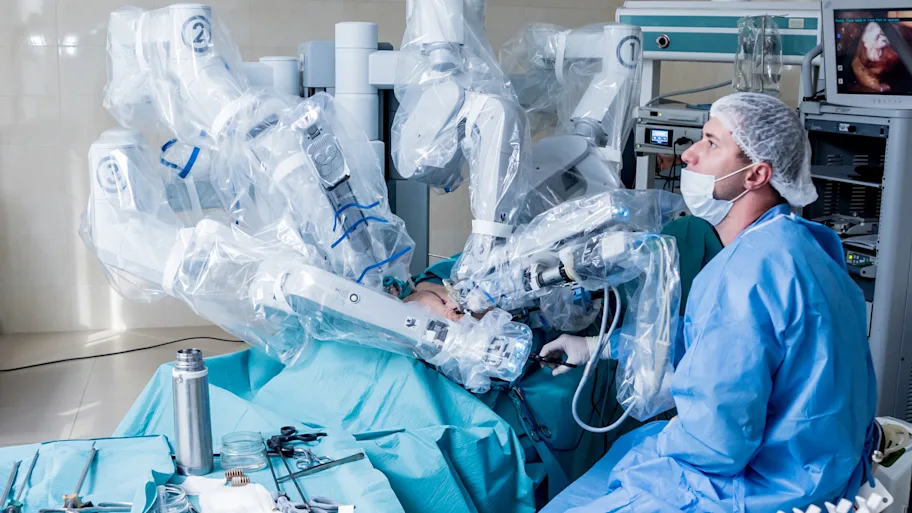
Embodying surgical robots with next-gen AI can safely augment practice if ethical and regulatory questions are addressed, say experts writing today in Frontiers in Science.
A team of pioneering surgeons and researchers from King’s College London says AI-enhanced surgical robotics could enable “true personalized surgery” and enhance the performance, situational awareness, decision-making, and effectiveness of surgical teams. Their analysis also addresses regulatory questions including reducing risks from systems that continue to learn and change after approval. It also tackles how we can prevent dataset biases from reinforcing inequalities, and how we address the concentration of research and industry in resource-rich nations.
Lead author and robotic urological surgeon Prof Prokar Dasgupta, formerly of King’s College London and Guy’s Hospital, London—who recently performed the UK's first long-distance robotic operation—said: “Using advanced AI and robotics in the operating room is very exciting. The next few years will see intelligent robots impact all stages of surgery—including techniques, emergency responses, team roles, workflows, and assistive functions.”
The authors warn that AI must sustain—not disrupt—operating rooms, and should support advances and refinement in surgical skill, procedure and technology, they warn. Most importantly, its use should be safeguarded by robust human and regulatory oversight, with surgeons remaining chief decision-makers.
Prof Dasgupta added: “With AI’s promise comes profound implications for clinical practice and the continued safe function of surgical teams. These warrant multistakeholder discussion to ensure clarity of liability, minimization of bias, integration of autonomous robotic systems within surgical teams, global equity, and robust product regulation.”
True personalized surgery
Anticipated advances include AI embedded into surgical robots, known as ‘embodied AI’, linked to sensor-equipped operating rooms that generate spatial understanding, adaptive learning, performance benchmarking, autonomous surgical assistance, and feedback to teams mid-operation.
Future surgical AI will also harness new data streams—gathered from patients, surgical teams, and sensors in robots—to provide real-time mid-operation guidance and decision support to optimize surgical actions.
Predictive AI could also allow surgeons to accurately visualize the outcomes of various actions before taking them—called cause-and-effect recognition. This could in the future be used to help improve patient outcomes.
First author Dr Alejandro Granados from King’s College London said: “Surgery is on the brink of a profound transformation, where technology will not only help predict outcomes but also guide clinicians toward the most optimal, personalized treatment for each patient.”
Regulating adaptive systems
Currently, regulators authorize medical technologies based on their submitted form—but AI-embodied surgical robots present a challenge given their ability to learn, adapt, and change post-approval.
To address this challenge, they authors call for regulatory reforms, including changes to licensing pathways, device classifications, post-market monitoring, and compliance standards to better serve the higher risk profile of changing systems.
Dr Granados said: “AI’s ability to learn presents an unprecedented puzzle. We are at a pivotal time in surgery where we need to begin answering those questions to ensure patients can benefit from the wealth of benefits AI-powered operating rooms bring.”
Clinical trials, the paper asserts, should adopt standardized metrics for evaluating AI software and assessing human–AI and human–robot interactions. It also recommends that regulators work alongside professional bodies to oversee surgical training as practice transitions from clinical expertise to data driven approaches.
It also recommends new models of collaboration between academia, industry and healthcare systems in lower income countries to build cost-effective AI and robotic ecosystems from which all can benefit.
Prof Dasgupta said: "We require a new set of frameworks—spanning regulatory and compliance, trial methods, reporting standards, and training approaches—to ensure the ongoing safety and effectiveness of robotics and AI in surgery.”
Dr Granados said: “Realizing this vision on a global scale will require careful stewardship. We must ensure that healthcare professionals and patients everywhere can benefit equitably from the compelling potential of AI and robotics innovation that is coming.”
Human decision-makers
The authors expect future iterations of robotics to operate with ever-greater degrees of autonomy while maintaining essential human oversight.
They describe how the surgeon’s role will shift towards supervision, coordination and high-level decision-making, while nurses, anesthetists and assistants can expect to gain additional skills. They also expect surgical teams to be complemented by clinical data scientists plus AI and robotic integration engineers.
Prof Dasgupta said: “Human surgeons must continue to be the chief decision-makers, and insights from AI models must be presented differently to members of the surgical team, based on their role, if we are to maintain the clear chain of authority necessary for safe surgical practice.”
Dr Granados said: “AI and robotics, strategically deployed in the operating room, will form the foundation of the shift towards systems that learn from every procedure, support surgical teams in real time, and potentially deliver safer, more precise, and better outcomes for patients.
“However, we must ensure that human judgment remains central, while addressing today’s unmet surgical needs and disparities in who benefits from access.”
--
The article is part of the Frontiers in Science multimedia article hub 'Surgical teams in the AI–robotics age'. The hub features an editorial, viewpoint, and a version of the article for kids, from other eminent experts: Dr Zorawar Singh and Prof Louis Kavoussi (Northwell Health, USA) and Prof Russell H. Taylor (Johns Hopkins University, USA).
About
Frontiers in Science is Frontiers’ flagship, multidisciplinary, open access journal focused on transformational science accelerating solutions for healthy lives on a healthy planet.
The journal publishes impactful peer-reviewed lead articles, invited from internationally renowned researchers, on scientific and technological advances addressing global challenges in human and planetary health. These are complemented by unique hubs of multi-audience content that create bridges between researchers, decision-makers, innovators, and the public—empowering people across all areas of science, policy, and society to share and build on these advances.
Reflecting its mission, Frontiers in Science has a panoramic scope encompassing human health and well-being, climate change, ecology and biodiversity, urban development, agriculture, food, water, and energy systems, computing, and social and economic sciences.
For more information, visit www.frontiersin.org/science and follow @FrontScience on X, Frontiers in Science on LinkedIn, and @Frontiers on Bluesky.
REPUBLISHING GUIDELINES: Open access and sharing research is part of Frontiers’ mission. Unless otherwise noted, you can republish articles posted in the Frontiers news site—as long as you include a link back to the original research. Selling the articles is not allowed.